Understanding the ISO 14000 Series for Environmental Management

The ISO 14000 series provides an internationally recognized framework for managing an organization’s environmental responsibilities. It helps organizations identify environmental aspects, meet compliance obligations, set objectives, monitor performance, and improve over time.
However, ISO 14000 is not a single certificate, and ISO 14001 certification is not proof that a company, product, or service has no environmental impact. Understanding that distinction is essential when assessing eco-certification claims and avoiding greenwashing.
What Is the ISO 14000 Series?
The ISO 14000 series is a family of international standards and guidance documents for environmental management. It helps organizations build consistent systems for addressing environmental risks, responsibilities, impacts, and performance.
Developed by the International Organization for Standardization (ISO), the family covers several related topics. These include environmental management systems, environmental auditing, environmental labeling, life-cycle assessment, greenhouse gas management, and environmental performance evaluation.
The central idea is structured management. Instead of treating environmental protection as a collection of isolated projects, an organization can use the ISO 14000 family to connect its policy, operational controls, legal duties, objectives, monitoring, and improvement activities.
The series does not prescribe one universal environmental target. A manufacturer, university, logistics company, and local authority will have different environmental aspects and impacts. The standards provide a management framework that can be adapted to each organization’s context, scale, activities, and compliance obligations.
This flexibility is useful, but it creates an important limitation: an ISO-based system can be well organized while the organization’s environmental performance remains uneven. Readers should therefore examine both the management system and the measurable results behind environmental claims.
ISO 14001 vs. the Wider ISO 14000 Family
The main difference is that ISO 14001 specifies requirements for an environmental management system, while other ISO 14000 standards offer guidance, methods, and tools for related environmental topics.
ISO 14001 is the best-known standard in the family because organizations can seek certification against its requirements. It defines what an environmental management system (EMS) must address, including environmental policy, planning, operational control, evaluation, and continual improvement.
Other standards serve different purposes. Depending on the organization’s needs, the wider family may support:
- Environmental auditing, including principles for planning and conducting audits.
- Life-cycle assessment, which examines environmental impacts associated with a product, process, or service across relevant life-cycle stages.
- Environmental labels and declarations, which help structure product-related environmental information.
- Environmental performance evaluation, using indicators to assess environmental results.
- Greenhouse gas accounting and reporting, including methods for quantifying emissions.
These documents should not automatically be described as certification standards. An organization may use guidance from the ISO 14000 family without being ISO 14001 certified. Conversely, ISO 14001 certification concerns the organization’s EMS and its defined scope, not automatic approval of every environmental statement it makes.
For a broader explanation of ISO’s role in standardization, readers can consult the official ISO standards resource.
How an ISO 14001 Environmental Management System Works
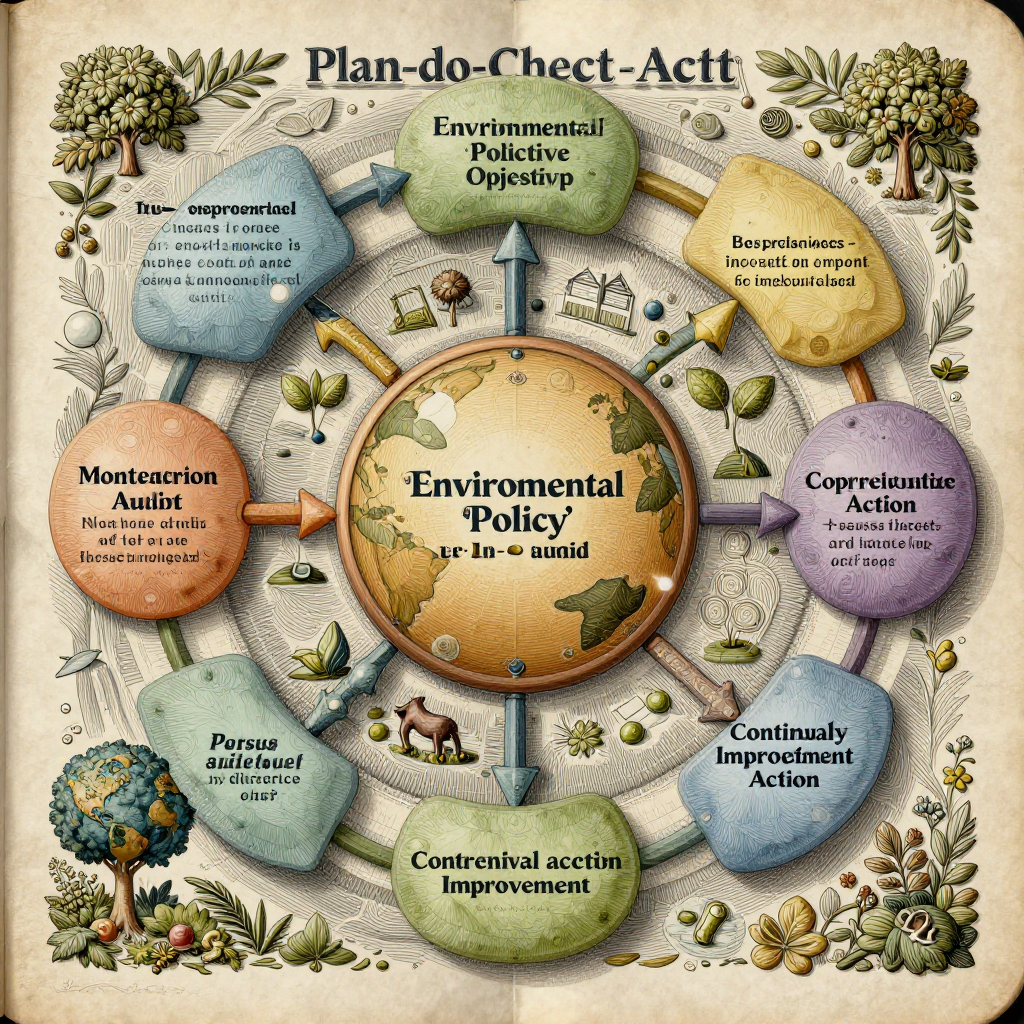
An ISO 14001 environmental management system works as a repeating cycle: understand environmental risks, plan controls and objectives, implement them, check results, correct weaknesses, and improve the system.
The process usually begins with the organization’s context and environmental policy. The policy sets broad commitments, such as protecting the environment, fulfilling compliance obligations, and improving the EMS. It should guide decisions rather than sit unused in a manual.
1. Identify environmental aspects and impacts
Organizations identify their environmental aspects, meaning activities, products, or services that can interact with the environment. Examples include fuel consumption, wastewater discharge, packaging, chemical storage, land use, noise, and waste generation.
An environmental impact is the resulting change, such as air pollution, water contamination, resource depletion, habitat disturbance, or contribution to climate change. The organization evaluates which aspects are significant and where controls are needed.
2. Determine compliance obligations
Compliance obligations include applicable laws, permits, regulations, contractual requirements, and voluntary commitments. An EMS should establish how the organization identifies these obligations, keeps relevant information current, and evaluates compliance.
Certification does not replace environmental regulators or legal enforcement. It assesses whether the EMS addresses compliance obligations in a systematic way; it does not grant permission to disregard environmental law.
3. Set objectives and control operations
Environmental objectives should connect to meaningful aspects and impacts. A company might target lower electricity use at a defined site, reduce hazardous waste, improve spill prevention, or increase the recovery of process materials.
Useful objectives include a baseline, a timeframe, responsible personnel, measurement methods, and resources. A vague ambition such as “be greener” cannot be monitored effectively.
4. Monitor, audit, and improve
The organization monitors environmental performance, investigates incidents, records corrective action, and conducts an internal audit. Internal audits test whether the EMS is implemented and functioning as planned.
Management review then considers audit findings, progress toward objectives, changing risks, compliance information, and opportunities for improvement. This creates a practical feedback loop rather than a one-time certification exercise.
What ISO Certification Does—and Does Not—Prove
ISO 14001 certification demonstrates that an independent conformity assessment process has found an organization’s environmental management system conforms to defined ISO 14001 requirements within a stated scope.
That is a meaningful assurance about the system. It indicates that the certified organization has documented processes and controls for managing environmental responsibilities, evaluating performance, and pursuing continual improvement.
Certification does not prove that:
- The organization has zero pollution, zero waste, or zero environmental impact.
- Every facility, subsidiary, supplier, or product is covered.
- The company is environmentally superior to all competitors.
- Every environmental claim in its advertising has been independently verified.
- The organization always complies with every environmental requirement without exception.
The scope matters. A certificate may cover one site, a defined group of activities, or selected business processes. It may exclude other locations, products, contractors, or supply-chain operations. Certification also differs from accreditation, verification, and self-declaration: a certification body audits the system, an accreditation body assesses the competence of certification bodies, and a self-declaration is made by the organization itself.
Choosing certification for stronger governance means accepting the cost of documentation, audits, training, and corrective action. It also means recognizing that a certified system is a management tool, not a shortcut to perfect environmental performance.
ISO 14000 and Greenwashing Risks
ISO-related greenwashing occurs when an organization presents a limited or ambiguous ISO credential as broad proof that its products or operations are environmentally friendly.
One common problem is vague language. Statements such as “ISO certified,” “ISO-approved product,” or “environmentally certified” hide the relevant standard, certificate holder, scope, and claim type. The ISO name or logo may also be used in ways that imply endorsement when no such endorsement exists.
Another risk is confusing organizational certification with product certification. ISO 14001 generally concerns an EMS operated by an organization. It does not certify that a particular package, garment, vehicle, building, or consumer product is greener than alternatives.
More credible communication identifies the exact facts: the certified organization, the applicable standard, the covered site or activity, the certification body, the certificate status, and the environmental information supporting any product claim.
Environmental claims should also use clear boundaries. A company may have reduced energy use at one facility while still causing significant impacts elsewhere. Reporting one improvement without explaining its scope can create a misleading overall impression, even when the statement is technically accurate.
How to Evaluate an Organization’s ISO Environmental Claims
To evaluate an ISO environmental claim, identify the standard, verify the certificate and scope, distinguish third-party certification from self-declaration, and look for measurable environmental evidence.
A practical five-question check
- Which standard? Is the claim specifically about ISO 14001, or does it vaguely mention the ISO 14000 family?
- Who is certified? Identify the legal organization named on the certificate, rather than assuming the entire corporate group is covered.
- What is the scope? Check the sites, activities, products, and processes included or excluded.
- Who assessed it? Determine whether a qualified certification body performed a third-party conformity assessment, or whether the organization made a self-declaration.
- What evidence supports the environmental benefit? Look for baselines, dates, boundaries, performance indicators, targets, and results.
A credible claim might say that a named facility operates an ISO 14001-certified EMS for specified manufacturing activities, with a certificate issued by a named certification body. A weak claim simply places “ISO certified” beside a product photograph and invites the audience to infer that the product itself is environmentally superior.
Consumers can also ask whether the claim explains what changed. Evidence may include energy, water, waste, emissions, or incident data, provided the organization explains the measurement boundary and comparison period. A certificate alone cannot answer those questions.
Using the ISO 14000 Series for Credible Environmental Improvement
Organizations use the ISO 14000 series credibly when they connect the EMS to measurable objectives, legal compliance, operational decisions, transparent reporting, and continual improvement.
A strong approach follows a simple evidence chain:
- Know the impact: identify significant environmental aspects and their potential impacts.
- Control the activity: establish procedures, training, maintenance, emergency planning, and supplier controls.
- Measure the result: track relevant indicators against a defined baseline and timeframe.
- Test the system: use internal audits, compliance evaluations, incident reviews, and management review.
- Communicate precisely: describe the certificate scope and separate system certification from product-level environmental claims.
Organizations should avoid selecting easy metrics solely because they produce favorable publicity. A credible environmental objective may reveal setbacks, changing conditions, or trade-offs. Publishing those limitations often makes the reporting more trustworthy than presenting a flawless story.
The ISO 14000 family can provide valuable structure, especially when environmental responsibilities span facilities, employees, contractors, and supply chains. Its credibility depends on how the system is implemented and how claims are communicated. Certification is a useful signal of management discipline, but meaningful environmental judgment still requires scope, evidence, context, and results.
Frequently Asked Questions
Is ISO 14000 the same as ISO 14001?
No. ISO 14000 refers to a family of environmental management standards and guidance documents. ISO 14001 is the specific standard that sets requirements for an environmental management system and can support third-party certification.
Does ISO 14001 certification mean a company is environmentally friendly?
No. It indicates conformity of a defined EMS with ISO 14001 requirements. It does not guarantee zero pollution, perfect compliance, sustainable products, or superior environmental performance.
Can ISO certification apply to a product?
ISO 14001 certification generally applies to an organization’s environmental management system, not an individual product. Product environmental claims require separate, appropriate evidence and should not imply that ISO 14001 endorses the product.
How can consumers identify misleading ISO environmental claims?
Look for the exact standard, certificate holder, certification body, scope, and supporting environmental data. Treat vague phrases such as “ISO-approved” or “ISO green product” as warning signs until the claim is clarified.
What does an ISO 14001 audit assess?
An audit assesses whether the organization’s environmental management system meets ISO 14001 requirements within its defined scope and whether the system is implemented and maintained. It does not certify every environmental outcome or product claim.