Case Study: Successes and Failures in Eco-Certification Programs
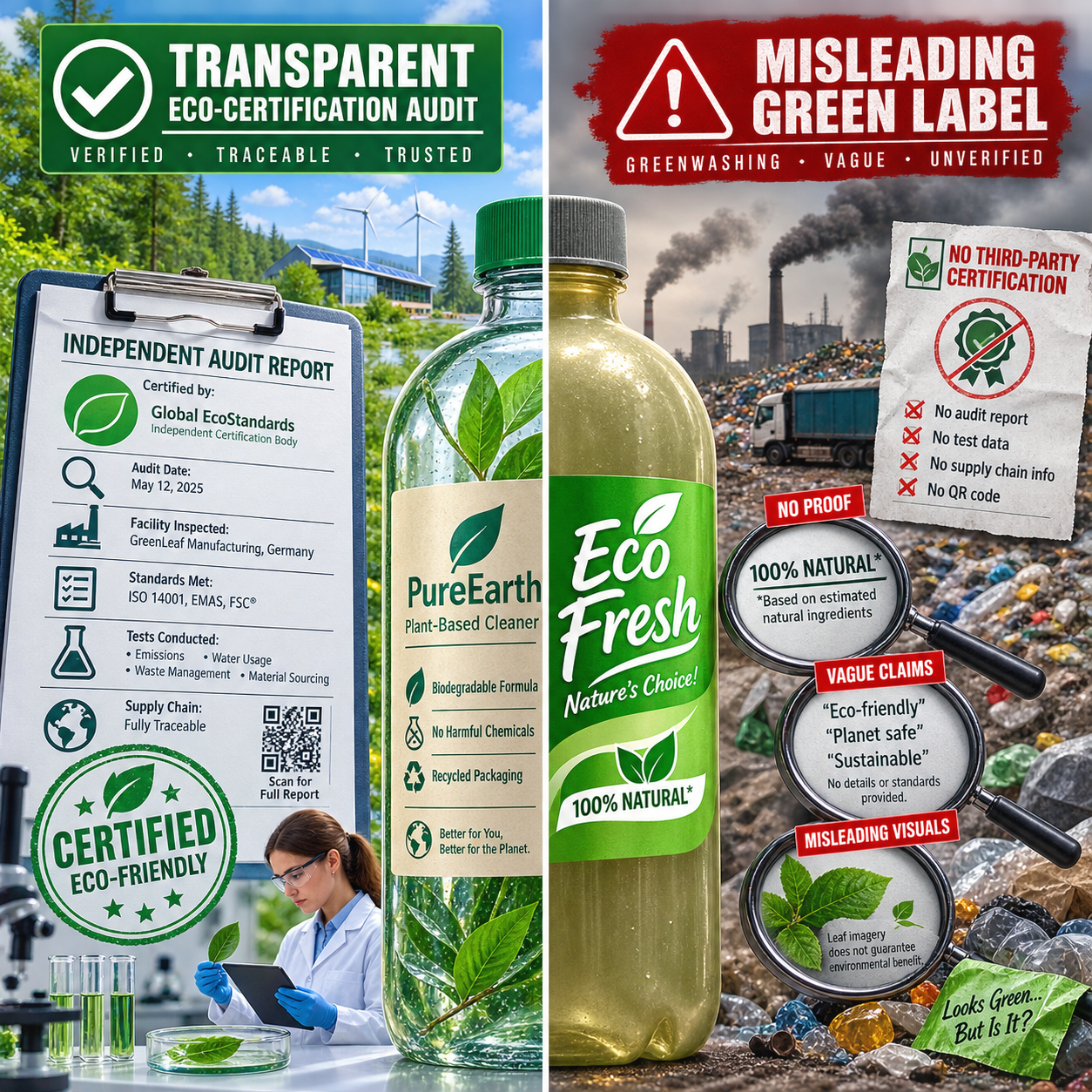
Eco-certification programs can turn environmental promises into measurable requirements, but a label alone does not prove that a product or organization is sustainable. Their value depends on the complete certification chain: credible environmental standards, clear certification criteria, independent assessment, auditing and compliance, transparent reporting, and effective corrective action.
This article uses two composite case studies rather than accusing any real organization. The successful example combines features found in well-governed certification systems; the weak example illustrates recurring structural risks. The central question is practical: does the program produce verifiable environmental improvement, or merely create the appearance of responsibility?
What Makes an Eco-Certification Program Credible?
A credible eco-certification program uses measurable environmental standards, independent third-party verification, transparent decision-making, and meaningful enforcement. It defines what is certified, checks evidence against that scope, and responds when participants fail.
Strong programs usually contain six connected safeguards:
- Specific standards: Requirements address defined issues such as energy use, water pollution, biodiversity, waste, emissions, or hazardous chemicals. They include thresholds, deadlines, and evidence requirements.
- Relevant certification criteria: The criteria match the product’s environmental risks. A packaging label, for example, should not rely only on recycled content if disposal, sourcing, and chemical additives are also significant concerns.
- Independent verification: An assessor must have technical competence and enough distance from the applicant to reduce conflicts of interest. Independence requires more than using the word third party.
- Auditing and compliance controls: Audits should review records, sites, suppliers, interviews, and sampling where appropriate. Paperwork alone can miss serious operational problems.
- Transparency: The public should be able to find the standard, certification scope, validity period, audit approach, limitations, and status of a certificate. A logo without accessible evidence has limited informational value.
- Corrective action and enforcement: Programs need graded responses, from deadlines for minor findings to suspension or withdrawal for serious breaches. Participants should not retain a claim indefinitely while problems remain unresolved.
Credibility also depends on supply-chain traceability. If a certificate covers only a factory but the environmental claim refers to the whole product, the scope is misleading. Traceability systems should show where relevant materials come from, which facilities handle them, and how changes are controlled.
One useful test is the evidence-to-claim ratio: the broader the public claim, the more extensive the supporting evidence must be. A narrow claim such as verified recycled content requires less evidence than a claim that a product is broadly sustainable.
Case Study of a Successful Eco-Certification Program
A successful eco-certification program links clear criteria to independent audits, stakeholder accountability, public reporting, and continuous improvement. Its environmental outcomes remain credible because certification is treated as an ongoing control system rather than a one-time marketing event.
The illustrative program
Consider a fictional forest-products certification program called GreenWood Standard. Its purpose is limited: to assess responsible forest management and chain-of-custody controls. It does not claim that every certified product has zero environmental impact.
GreenWood begins with measurable requirements for habitat protection, legal harvesting, worker safety, community consultation, and regeneration. Applicants must map management areas, document harvest plans, and maintain records linking raw material to finished goods. The standard also includes stakeholder procedures, allowing local communities and environmental groups to submit concerns before and during certification.
Independent certification bodies conduct on-site assessments. Auditors sample management records, inspect harvesting areas, interview workers, and compare purchase documents with production volumes. The certification decision is separated from the commercial team that negotiated the audit, reducing the risk that revenue pressure determines the result.
When auditors identify a weakness, the operator receives a corrective-action deadline. A missing record may require a short-term fix; illegal harvesting or destruction of protected habitat can trigger suspension while the issue is investigated. Public certificate records disclose the certified entity, scope, status, and major findings, subject to legitimate confidentiality limits.
The program also revises its criteria periodically. New requirements may address improved satellite monitoring, climate resilience, or stronger protections for high-conservation areas. This creates a pathway for progress, although it can increase costs for small operators. That trade-off is acceptable only when the program offers practical guidance, proportional fees, and support for compliance.
The important outcome is not the logo. It is the chain of evidence connecting a defined forest-management claim to observed practices, supply-chain records, independent review, and consequences for non-compliance.
Case Study of a Failed or Weak Certification Program
A weak certification program usually fails because its environmental requirements are vague, its verification is too dependent on applicants, and its penalties do not outweigh the commercial value of the label. In that setting, certification can become a credibility shield for unverifiable claims.
The illustrative failure
Imagine a fictional consumer-goods label called EarthChoice Verified. Its marketing promises products made with responsible materials, but its public standard contains broad phrases such as “supports sustainability” and “minimizes environmental harm.” It does not define acceptable thresholds, required evidence, or the product’s certified boundaries.
Manufacturers pay the program operator directly for an assessment. Auditors review a questionnaire and selected company documents, but rarely visit facilities or verify suppliers. The program accepts corporate policies as evidence of performance. A product may therefore receive certification because its owner has an environmental policy, even when actual energy use, pollution controls, or sourcing practices remain unknown.
Several weaknesses follow:
- Conflicts of interest: The assessor’s commercial relationship with the applicant is not disclosed, and there is no visible separation between sales and certification decisions.
- Limited scope: The label appears on the finished product, while the assessment covers only one manufacturing site and excludes raw materials, transport, or end-of-life impacts.
- Weak oversight: Certificates renew automatically unless someone submits a complaint, placing the burden of detection on outsiders.
- Insufficient penalties: Serious findings lead to recommendations rather than suspension, so the label remains valuable even when compliance is uncertain.
- Opaque evidence: Consumers cannot see the standard, audit dates, findings, or certificate status.
People may interpret the logo as proof of broad environmental performance. That interpretation exceeds the evidence. The failure is therefore both technical and communicative: the certification criteria are weak, and the label encourages a stronger conclusion than the program can support.
How Greenwashing Enters the Certification Process
Greenwashing enters certification when a program or participant presents a narrow, selective, or weakly verified environmental achievement as broad proof of sustainability. It can occur through labels, advertising, selective disclosure, or unclear certification scopes.
Common entry points include:
- Vague labels: Words such as natural, planet-friendly, or responsible lack meaning unless tied to defined requirements and evidence.
- Selective disclosure: A company highlights one improved input while omitting major emissions, waste, labor, or sourcing problems.
- Superficial compliance: Staff complete forms and adopt policies, but auditors do not test whether practices operate in the field.
- Scope confusion: Certification applies to a factory, ingredient, or single process, while marketing implies that the entire brand or product is certified.
- Logo inflation: A private symbol resembles an official eco-label but offers no explanation of governance, criteria, or independent review.
Consumers should ask, “What exactly was certified?” A credible answer names the product, site, material, period, criteria, and verifier. Guidance from the U.S. Federal Trade Commission Green Guides also illustrates why environmental marketing claims should be clear, qualified, and supported by evidence.
Certification cannot eliminate greenwashing by itself. It reduces the risk only when claims are narrower than, or accurately reflect, the verified evidence. A certificate may verify recycled content while saying nothing about carbon neutrality, worker conditions, or total product impact.
Comparing Successes and Failures
The decisive difference between successful and failed eco-certification programs is the connection between a claim, reliable evidence, independent judgment, and consequences. A polished label matters far less than governance and follow-through.
| Area | Stronger program | Weak program |
|---|---|---|
| Governance | Public rules, stakeholder input, conflict controls | Private rules with unclear decision-making |
| Standards | Measurable thresholds tied to material risks | Broad language and undefined aspirations |
| Verification | Competent, independent, risk-based assessment | Self-reporting or document-only review |
| Traceability | Records link inputs, facilities, and certified outputs | Supply-chain boundaries remain unclear |
| Transparency | Public scope, status, methodology, and findings | Logo and marketing copy with little evidence |
| Enforcement | Deadlines, follow-up audits, suspension, withdrawal | Recommendations without meaningful consequences |
| Outcomes | Measured improvement and published limitations | Visibility increases without proof of impact |
There is also a cost trade-off. Rigorous auditing, traceability, and public reporting require money and staff time. Lower-cost certification may improve access for small businesses, but cost reduction becomes dangerous when it removes the controls that make certification trustworthy.
A Practical Checklist for Evaluating Eco-Certifications
To evaluate an eco-certification, verify its scope, standards, assessor independence, evidence, transparency, and response to non-compliance. If several answers are unclear, treat the label as a limited signal rather than proof of broad environmental performance.
- What is certified? Identify the exact product, facility, material, service, or management system.
- Which environmental standards apply? Look for measurable criteria, thresholds, prohibited practices, and evidence requirements.
- Who verifies compliance? Check the assessor’s competence, accreditation where relevant, independence, and conflict-of-interest policy.
- How is the audit performed? Ask whether the process includes site visits, interviews, supplier checks, sampling, and risk-based follow-up.
- Can the supply chain be traced? Determine whether certified inputs can be reconciled with production and sales records.
- What information is public? Look for the standard, certificate number, dates, scope, status, limitations, and complaint process.
- What happens after failure? A credible program explains corrective action, deadlines, suspension rules, appeals, and certificate withdrawal.
- Does the marketing claim stay within the evidence? A narrow verified attribute should not be presented as proof that the entire product is environmentally superior.
Consumers can also compare the label’s claim with independent product information. Businesses should keep audit records, supplier evidence, and claim approvals together so marketing language does not outrun technical verification.
Lessons for Businesses, Consumers, and Certification Bodies
Businesses, consumers, and certification bodies improve eco-certification when they match claims to evidence, treat audits as improvement tools, and make non-compliance visible. Shared accountability is essential because no single participant controls the full certification chain.
For businesses
- Choose programs with published standards and independent verification, even when a cheaper logo is available.
- Map certification boundaries before making environmental claims.
- Track supplier data, corrective actions, and evidence of implementation rather than relying on policy statements.
- If an audit is failed, stop or qualify the affected claim, investigate the root cause, complete corrective action, and document follow-up verification.
For consumers
- Read the claim beside the logo and distinguish certification from a self-declared green claim.
- Look for scope, dates, verifier details, and accessible criteria.
- Be cautious when a label uses broad environmental language but provides no evidence or limitations.
For certification bodies
- Separate commercial sales from certification decisions and disclose governance arrangements.
- Use risk-based audits, public complaint channels, and consistent enforcement.
- Publish limitations and adverse findings in a way that informs rather than protects the brand.
- Review standards as science, technology, and environmental risks change.
Credible certification is best understood as a monitored promise. It earns consumer trust when standards are meaningful, verification is independent, supply chains are traceable, and failures trigger visible correction. Without those conditions, an eco-label may decorate a claim without proving it.
Frequently Asked Questions
What is the difference between eco-certification and a self-declared green claim?
Eco-certification normally involves defined criteria and assessment by an external body. A self-declared green claim comes from the business itself and may be legitimate, but consumers must evaluate its evidence and wording directly.
How can consumers identify a credible eco-label?
Check the label’s owner, standard, certification scope, independent verifier, certificate dates, public records, and enforcement policy. A credible label explains what it verifies and what it does not cover.
Can certification programs prevent greenwashing?
They can reduce greenwashing risk, but they cannot prevent it automatically. Weak standards, unclear scopes, selective disclosure, and poor enforcement can allow misleading claims to survive inside a certification system.
What should businesses do if they fail an environmental audit?
Businesses should correct the underlying problem, record the action, meet the stated deadline, and obtain follow-up verification. They should also pause or revise environmental claims that the failed audit undermines.
Why are independent audits important?
Independent audits reduce the chance that commercial interests control the certification decision. Their value depends on auditor competence, sufficient access to evidence, impartial governance, and consequences when findings are ignored.