Greenwashing vs. Genuine Sustainability: How to Tell the Difference
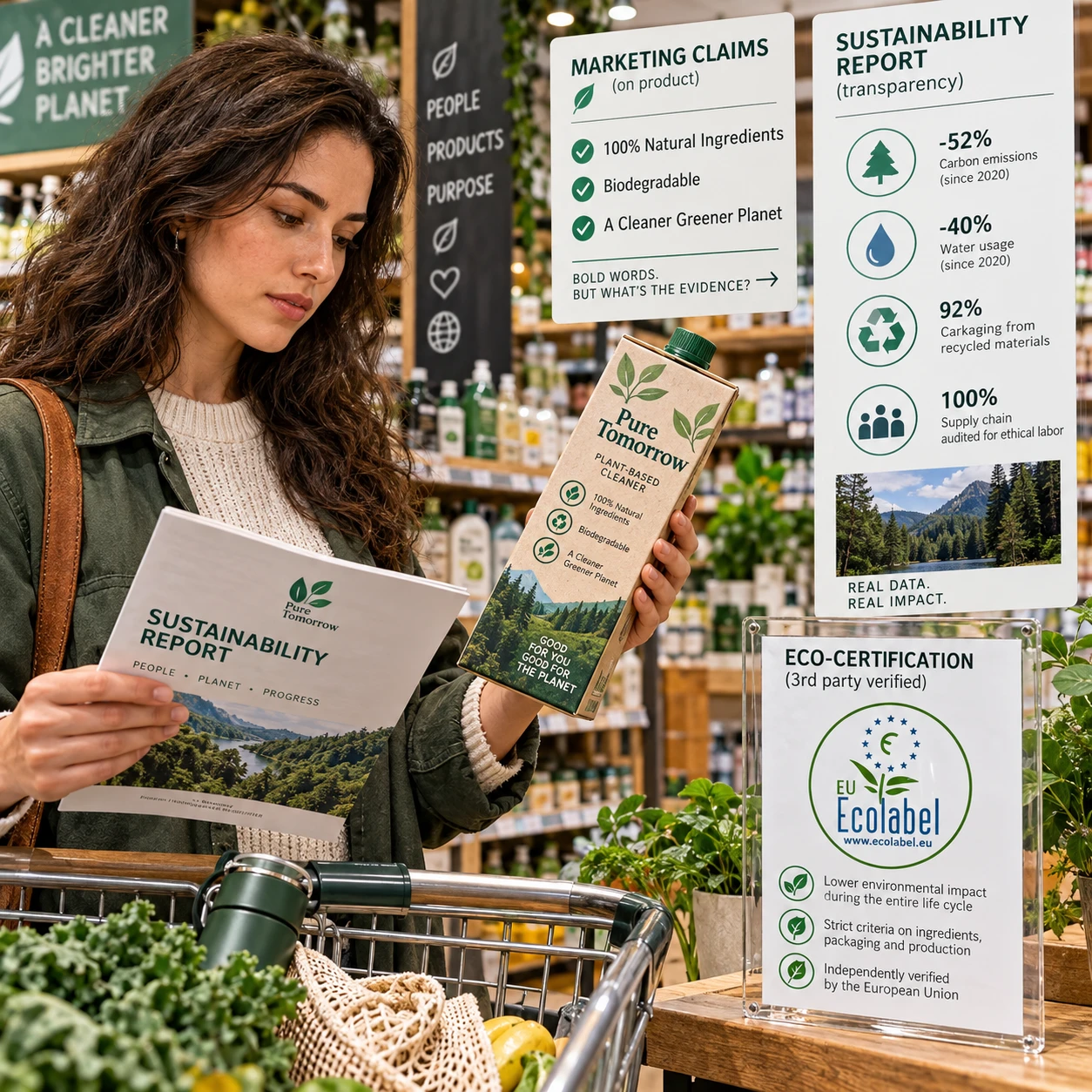
A package marked “green” or “planet-friendly” can look reassuring, but the label alone tells you little about its environmental impact. To distinguish greenwashing from genuine sustainability, look for specific claims, accessible evidence, clear boundaries, and independent verification.
This approach helps you compare products and companies without assuming every environmental claim is false—or that one certification proves a brand is sustainable in every way.
What greenwashing and genuine sustainability mean
Greenwashing is environmental marketing that misleads people about a product or company’s impact. Genuine sustainability involves measurable action to reduce harm, supported by evidence that explains what has improved and what still needs work.
The difference matters because environmental claims can shape what consumers buy, while vague or misleading language makes meaningful progress difficult to recognize. A company might highlight recycled packaging while saying nothing about the product’s materials, energy use, or supply chain. That omission does not automatically prove deception, but it limits what the claim tells you.
Think of a sustainability claim as a small report, not a verdict. Ask three questions: What is being claimed? What evidence supports it? How much of the product or business does it cover? This simple test separates a narrow, supportable statement from a broad impression that the evidence may not justify.
Genuine sustainability is also a direction of travel, not a claim of perfection. A company can still have environmental impacts while setting credible goals and reporting progress. The important distinction is whether its messaging accurately reflects the scope and pace of its actions.
Common signs of greenwashing
Greenwashing often relies on broad language, selective information, or visual cues that imply more than the evidence shows. Treat these as reasons to investigate further, rather than automatic proof that a claim is false.
Vague words such as “eco-friendly,” “natural,” “clean,” and “green” are difficult to assess without a clear explanation. They may refer to one ingredient, a packaging change, or a specific manufacturing step, rather than the product’s full lifecycle impact. Look for a definition, a measurable result, and a stated comparison.
Selective disclosure happens when a company promotes one improvement but leaves out other relevant impacts. For example, a “recyclable” package may still be hard to recycle in places where collection facilities are limited. The claim may be accurate under certain conditions, but those conditions matter.
Other warning signs include:
- Unsupported promises: Future targets appear without a baseline, interim milestones, or progress updates.
- Unclear comparisons: “Uses less plastic” gives no reference product, time period, or amount saved.
- Nature-themed imagery: Leaves, forests, and earthy colors create a green impression but do not verify environmental performance.
- Hidden scope: A claim applies to one product line or facility, while the wording suggests it covers the whole company.
A useful rule: if the headline claim is broad but the supporting detail is hard to find, check whether the message gives you a fair picture or merely a favorable slice.
What credible sustainability looks like
Credible sustainability claims name the action, define its scope, and provide evidence you can check. Stronger reporting also explains the baseline, timeframe, and remaining limitations.
Compare “better for the planet” with “the bottle contains 50% recycled plastic by weight, compared with our previous version.” The second claim is more useful because it identifies the product feature and comparison. Ideally, the company also explains how the percentage was calculated and whether the figure applies to every bottle or only certain sizes.
Look for a chain of evidence:
- Specificity: The claim identifies a material, process, emissions category, or other measurable issue.
- Scope: It states which products, sites, suppliers, or business activities are included.
- Evidence: It links to data, a methodology, or a report rather than asking you to rely on a slogan.
- Accountability: It shows progress against a baseline and describes setbacks or changes to the plan.
- Verification: Where appropriate, an independent party checks the data or compliance.
Supply chain transparency matters because many impacts occur before a product reaches a store: during raw-material extraction, farming, manufacturing, and transport. Lifecycle impact also includes use and disposal. No single metric captures everything, so credible communication explains what it measures and what it leaves out.
How to assess eco-certifications
An eco-certification can offer useful evidence when its standard is clear and compliance is checked, but no single label proves that a product or company is sustainable in every respect.
Start by identifying the organization behind the label. Then read the certification standards: What environmental issues do they cover? Do they apply to one ingredient, a manufacturing site, packaging, or the entire product? A narrow certification may be valuable within its scope while saying nothing about other impacts.
Next, check how compliance is verified. Find out whether the certification uses document reviews, on-site audits, product testing, or another method; whether audits are independent; and how often certified businesses are reassessed. Also look for public criteria and a process for handling non-compliance. The more clearly a program explains these details, the easier it is to judge what the label means.
Third-party verification can strengthen a claim, but it is not a substitute for reading its boundaries. Some programs certify a specific attribute rather than overall sustainability, and standards can vary in rigor. Certification may also involve fees, which is a reason to examine governance and verification—not to dismiss every paid program.
When a label is unfamiliar, search the certifier’s own website for its standard and verification process. If the brand provides only a logo without naming the program or linking to details, treat the certification as a prompt to ask questions, not as conclusive proof.
A practical checklist for evaluating a brand
To evaluate a sustainability claim, identify its scope, find its evidence, and test whether the wording matches what the evidence supports. These questions work for a product label, company website, or sustainability report.
- What exactly is the claim? Can you restate it in measurable terms?
- What does it cover? One feature, one product, a facility, a supply chain, or the whole business?
- Compared with what? Is there a baseline, reference product, or time period?
- Where is the evidence? Is there a report, methodology, certification standard, or accessible data?
- Who checked it? Was there independent third-party verification, and what did it examine?
- What is left out? Does the information address materials, production, use, and disposal where relevant?
- Is progress reported? Can you see updates, missed targets, or changes in approach?
For example, a clothing brand might claim a jacket is made with recycled fibers. Check the percentage, which components it applies to, and whether the claim comes from a product specification or an independently verified standard. Then consider what that statement does not cover, such as dyeing, manufacturing energy, or garment durability.
Use the answers to assess the claim, not to label an entire company based on one detail. A well-supported improvement can be meaningful even when it does not resolve every environmental issue.
What to do when claims are unclear
When an environmental claim is unclear, look for its definition and supporting evidence before relying on it. If key details remain missing, compare it with claims that offer clearer scope and verification.
Search the company’s sustainability or product pages for a methodology, baseline, certification details, and recent progress. If those are absent, contact the company with a focused question: “Does this recycled-content claim apply to the whole product, and how is the percentage verified?” A specific question is easier to answer than a general request for proof that a brand is “sustainable.”
Compare like with like. A packaging claim cannot establish that one company has a lower overall impact than another, and a certification focused on one material does not assess every stage of a product’s lifecycle. Use labels as one evidence point alongside product information, supply chain transparency, durability, and end-of-life options.
Be cautious about turning uncertainty into an accusation. Missing information means you cannot verify a claim from the available evidence; it does not by itself establish intent to mislead. If you want to make a purchase decision, choose the option with clearer, more relevant evidence—or wait until the company answers your questions.
Frequently asked questions
Quick answers can help put eco-labels and environmental claims in context. In each case, check the scope and evidence before drawing a broader conclusion.
Is a product with an eco-label automatically sustainable?
No. An eco-label usually confirms that a product or process meets particular certification standards. Check which impacts the label covers and how compliance is verified; it may not assess the full lifecycle or the company’s overall performance.
What words should make me question an environmental claim?
Words such as “green,” “eco-friendly,” “natural,” and “planet-safe” deserve follow-up when they appear without a definition or evidence. They are not proof of greenwashing on their own, but you should ask what measurable feature they describe.
How can I check whether a sustainability certification is credible?
Identify the certifying organization, read its published standard, and check its audit or verification process. Confirm what the certification covers, how often compliance is reviewed, and whether the organization explains how violations are handled.
Can a company be sustainable if it still has environmental impacts?
Yes. Most products and businesses have some environmental impact. Judge whether the company measures relevant impacts, works to reduce them, reports progress honestly, and avoids presenting limited improvements as proof of complete sustainability.